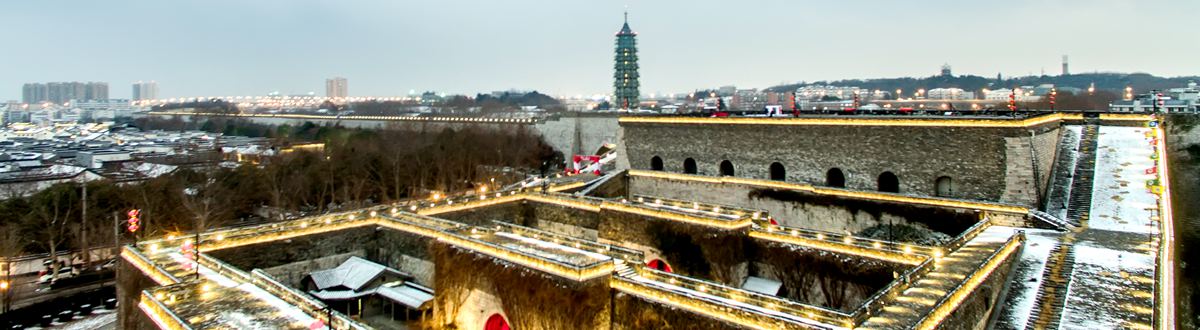
This section of the city wall is about 6 kilometers long, with 5 entrances to the city wall. There are three basic exhibitions: Fuguilou Site Exhibition (Fuguilou), Nantang Cultural and Historical Exhibition (Nantang Site), Zhonghua Gate Basic Exhibition (Zhonghua Gate). There are four cultural facilities: Jiqing Bookstore (Jiqing Gate), Fenghuangtaishang (Xigan Lane), Jubao Shuyuan (Zhonghua Gate), Jinling Shuyuan (Wuding Gate), Wenchuang Service Center and so on.
Jubao Gate: Located in the south of Nanjing City, sitting in the north and facing the south, it has great momentum and is called "the largest urn city in the world". For hundreds of years, city buildings have been destroyed and built repeatedly, and the system of Ming Dynasty has basically not changed. In 1928, it was renamed "Zhonghua Gate", and the following year, Chiang Kai-shek inscribed "Zhonghua Gate" and inscribed the amount of the city gate, which has been retained to this day. In 1937, the triple eaves of Xieshan Peak in Ming Dynasty were destroyed by Japanese invaders. Today, the masonry structure of the city gate and urn city buildings is basically well preserved.
Wuding Gate: In 1927, due to the need of urban construction, the city was demolished to open the drainage channel. In 1934, Wuding Gate was built. In 1958, Wuding Gate was demolished. In 2007, the new three-arch coupon gate at the original site was still named Wuding Gate.
Dongshuiguan Site Park: Dongshuiguan Site Park is located in the southeast of Nanjing City, west of Tongjimen Bridge on Longpan Middle Road. It is the entrance of Qinhuai River into Nanjing City and the only lock entrance of Nanjing Ancient City Wall. Therefore, Dongshuiguan has naturally become the "leader" of the Qinhuai River.